

How Art Connects Us All

Standing in front of a piece of art makes time bend. Museums, with their vaulted ceilings, are my sanctuary, a quiet space where the soft hum of silence aligns with my thoughts. Art has always been where everything clicks for me: the colors, the textures, the unspoken dialogue between the canvas and the observer. I’ve never understood the need to confine my interests to just one realm when all aspects of life are so beautifully intertwined. While history offered some comfort, it often felt like a collection of distant facts. I craved something more.
I remember my first art history lecture, a class I chose merely to fulfill a credit requirement but which became a revelation. I realized that history, often penned by eloquent storytellers, was limited to the facts they deemed important. It told a riveting story, yes, but not the whole story. Art didn’t just record history; it breathed life into it. It allowed me to step into someone’s emotions, to see the world not through the detached lens of selective narratives but as it was authentically lived. Art became a language for feelings I couldn’t name, a connection to stories I hadn’t lived but somehow knew by heart. It invites us into different perspectives, immortalizing the essence of moments, people, and experiences. In brushstrokes, sculptures, and canvases, I found what history books could never offer: an intimate understanding of how people felt. Art reveals that across every era, we are bound by a common thread.
At our core, we all quietly yearn for the same things: to love, to be loved, and to find safety in life, in love, and in solitude.
This realization that art bridges the gap between us continues to draw me into its core. I often feel as if I’m piecing together parts of myself left in the care of strangers. Each piece I encounter feels like a fragment of myself I’ve left behind, and by assembling them, I make myself whole, both within and in harmony with the world around me. This is the pull of art: the simultaneous journey into another’s truth and deeper into one’s own. Art holds up a mirror, not to show you who you are, but to reflect the parts of yourself you’ve kept hidden—the parts you can’t dismiss that still deserve care. Walking through the Armory Show felt like embarking on a journey through countless worlds, each artwork a portal into a different life, culture, and emotion. This year’s event, led by Kyla McMillan, a woman in the art space with whom I find I have much in common, was more than an exhibition; it was a celebration of diversity and a testament to how art should reflect our evolving landscape. Contemporary Art from every corner of the world converged under one roof to reflect and appreciate the threads we share. There, Khalif Tahir Thompson’s piece pulled me in first.
Khalif Tahir Thompson’s Shielded Moments
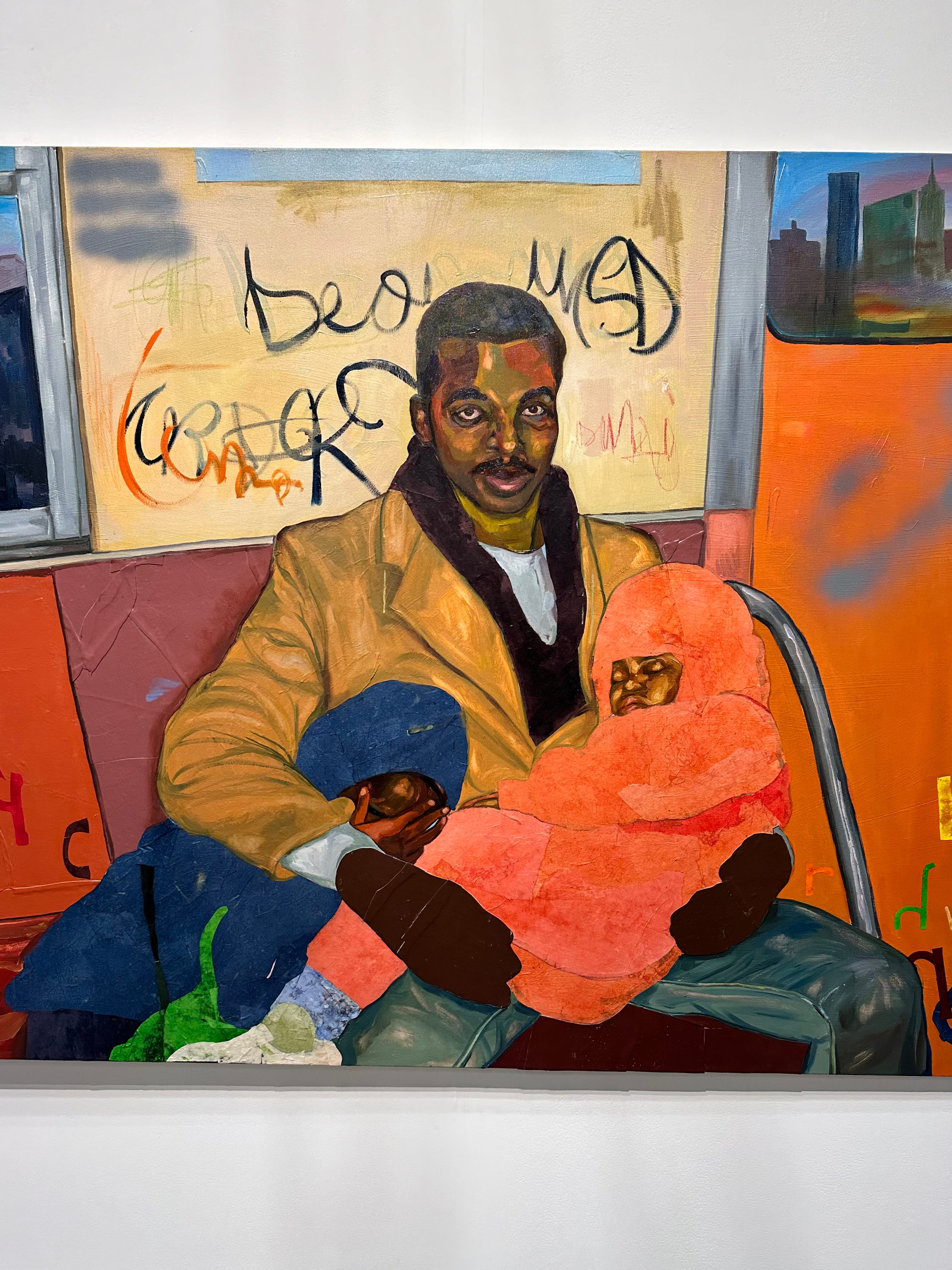
Khalif Tahir Thompson
Scratch, 2024
Oil, fabric, pleather, handmade paper, papyrus, collage on canvas
59 × 82 5/8 in. (150 × 210 cm)
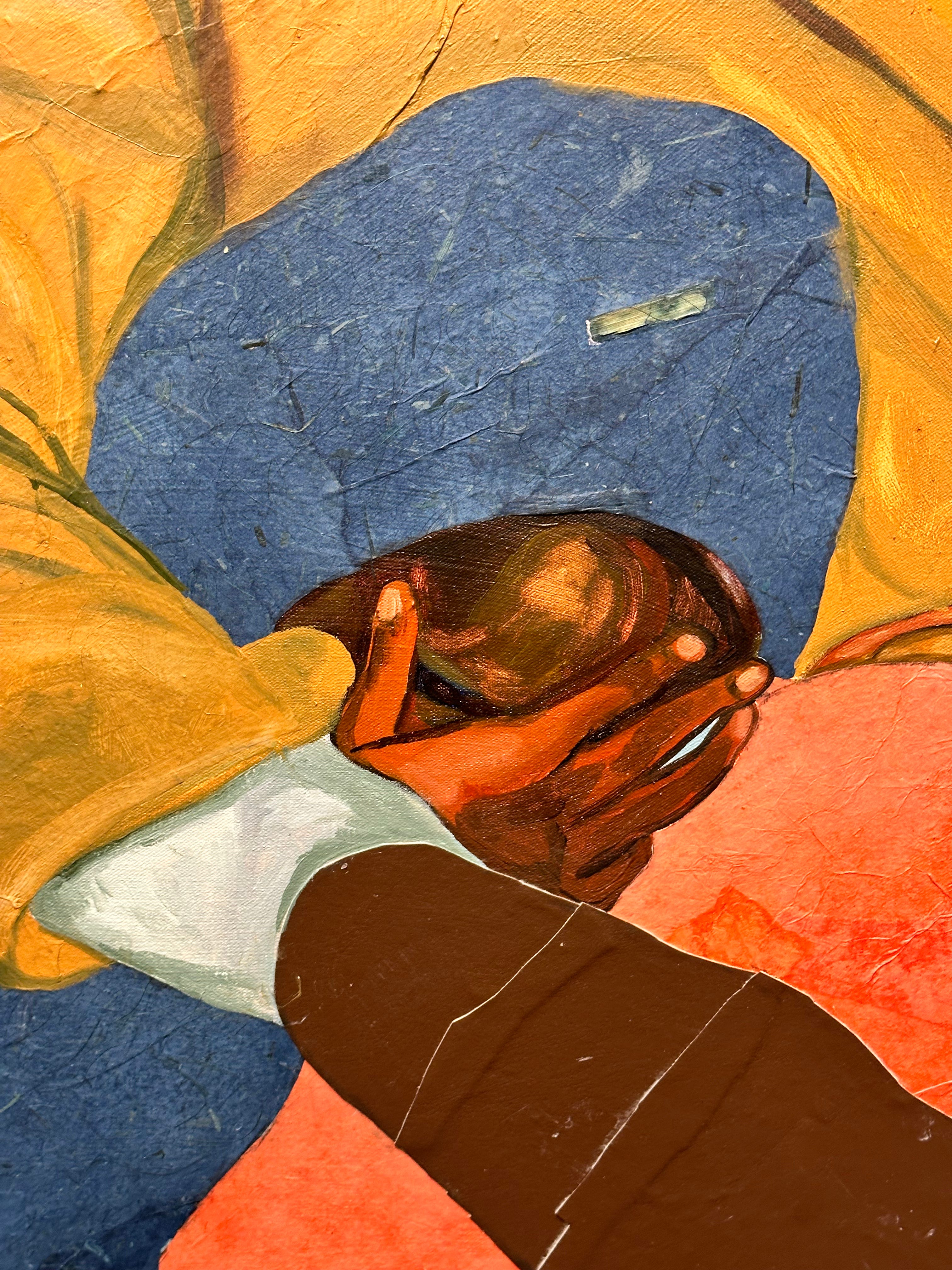
The first piece that drew me in was by Khalif Tahir Thompson. From across the room, it felt familiar. It depicted a man cradling his two children on a subway, a tender moment amidst the city’s chaos. The father’s protective embrace encased them like a shield, stirring memories of my own childhood and the safe cocoon of a parent’s love.
Thompson’s mastery lies in his blend of oils and mixed media, which gives his figures a lifelike presence, and in the emotional depth he captures. Layers of color and texture echo layers of emotion, creating a richness that invites your gaze. The duality of vulnerability and strength struck me. One child hides his face behind tiny hands. Is he sleeping or shielding himself from the world? These subtleties speak volumes. At that moment, I saw myself. How often do we, as adults, hide behind our masks—our titles, successes, curated images? We are expected to project confidence at all times, yet beneath the surface, we shelter our true selves, yearning for safety and acceptance. Thompson’s painting held up a mirror, reflecting the subjects on the canvas and the parts we keep concealed.
His work invites us to consider the spaces where we feel protected. It whispers a question: When do we allow ourselves the freedom to be vulnerable, to let down our guard? The tenderness captured in the father’s embrace reminds me that strength is not diminished by vulnerability but rather enriched by it.
Natvar Bhavsar’s Cosmic Embrace
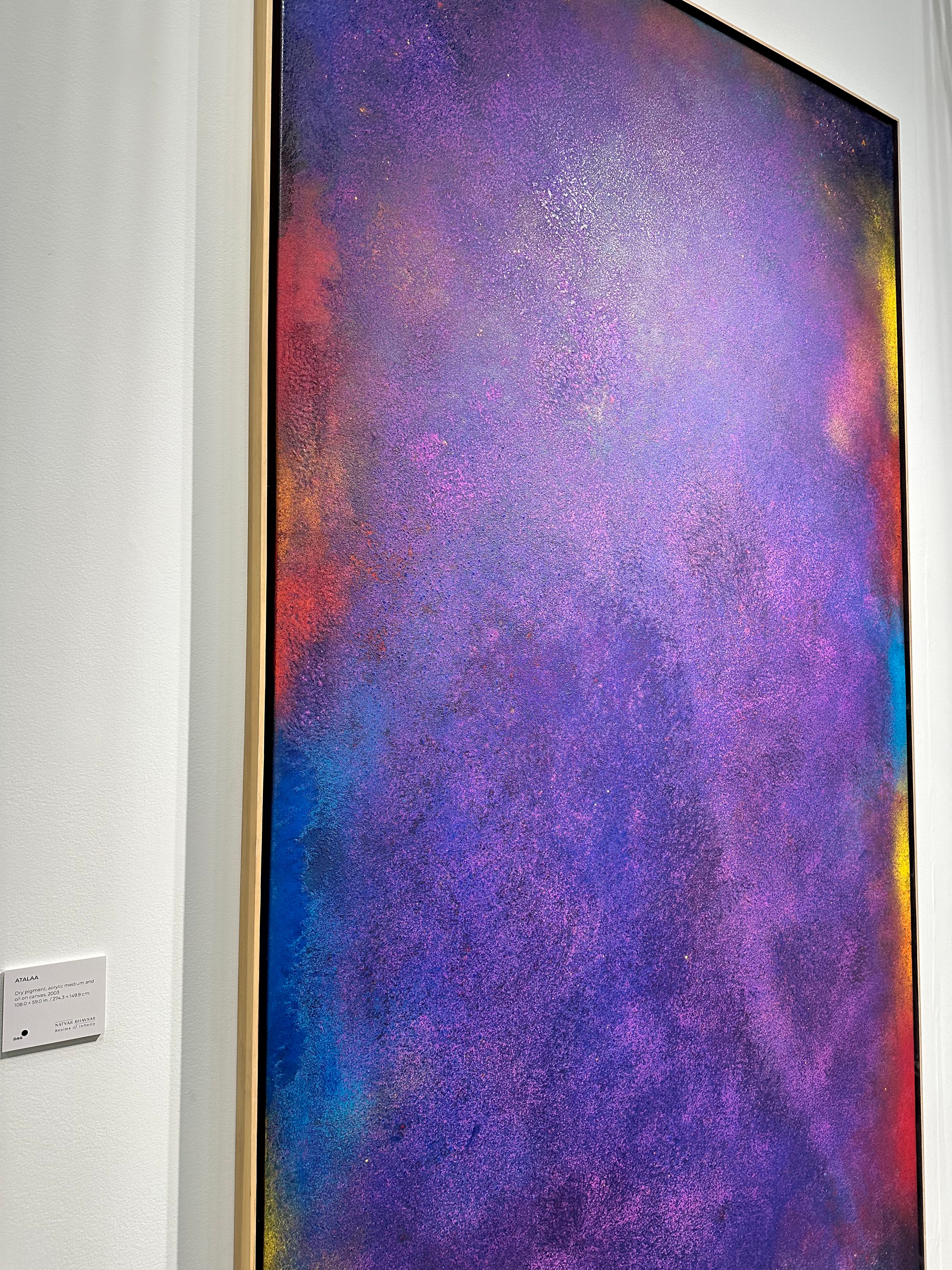
Natvar Bhavsar
ATALAA, 2003
Dry pigment, acrylic medium, and oil on canvas
108 × 59 in. (274.3 × 149.9 cm)
Abstract art has always puzzled me. While I appreciate its place in art, I often search for meaning in the disarray. When I first glimpsed Natvar Bhavsar’s work, I was skeptical. From a distance, it appeared as a vast expanse of indeterminate color, a nebulous cloud of purples, yellows and blues. I thought to myself, “Just another abstract piece demanding attention.”
Yet something compelled me to step closer. As I approached, the painting transformed. Up close, countless specks of pigment danced across the canvas, each granule contributing to a cosmic expanse. It was as if I were peering into the depths of the universe, witnessing galaxies form and dissipate. The texture was rich, layered, and inviting. I felt both like a granule; small yet united. The painting wasn’t clamoring for attention; it quietly invited me to lose myself in its depths. Bhavsar’s use of color and texture creates a meditative space, a silent dialogue between the viewer and the infinite. It was a cosmic embrace, a reminder of the vastness of existence and my place within it.
On the show’s first day, Bhavsar sat nearby while I observed this piece. His demeanor was calm and unassuming, yet his presence mirrored the heart of his work: profound yet unobtrusive. Unlike other abstract pieces that call for recognition, his painting was a gentle whisper, saying, “Stay if you wish.” Bhavsar’s work challenged my preconceptions. It reminded me that sometimes, meaning isn’t immediately apparent. It unfolds as we allow ourselves to be present. It revealed the beauty in subtlety and the power of quiet persistence. In a world that often values the loud and the bold, there’s strength in the understated.
Wilmer Wilson IV’s Imprints of Persistence
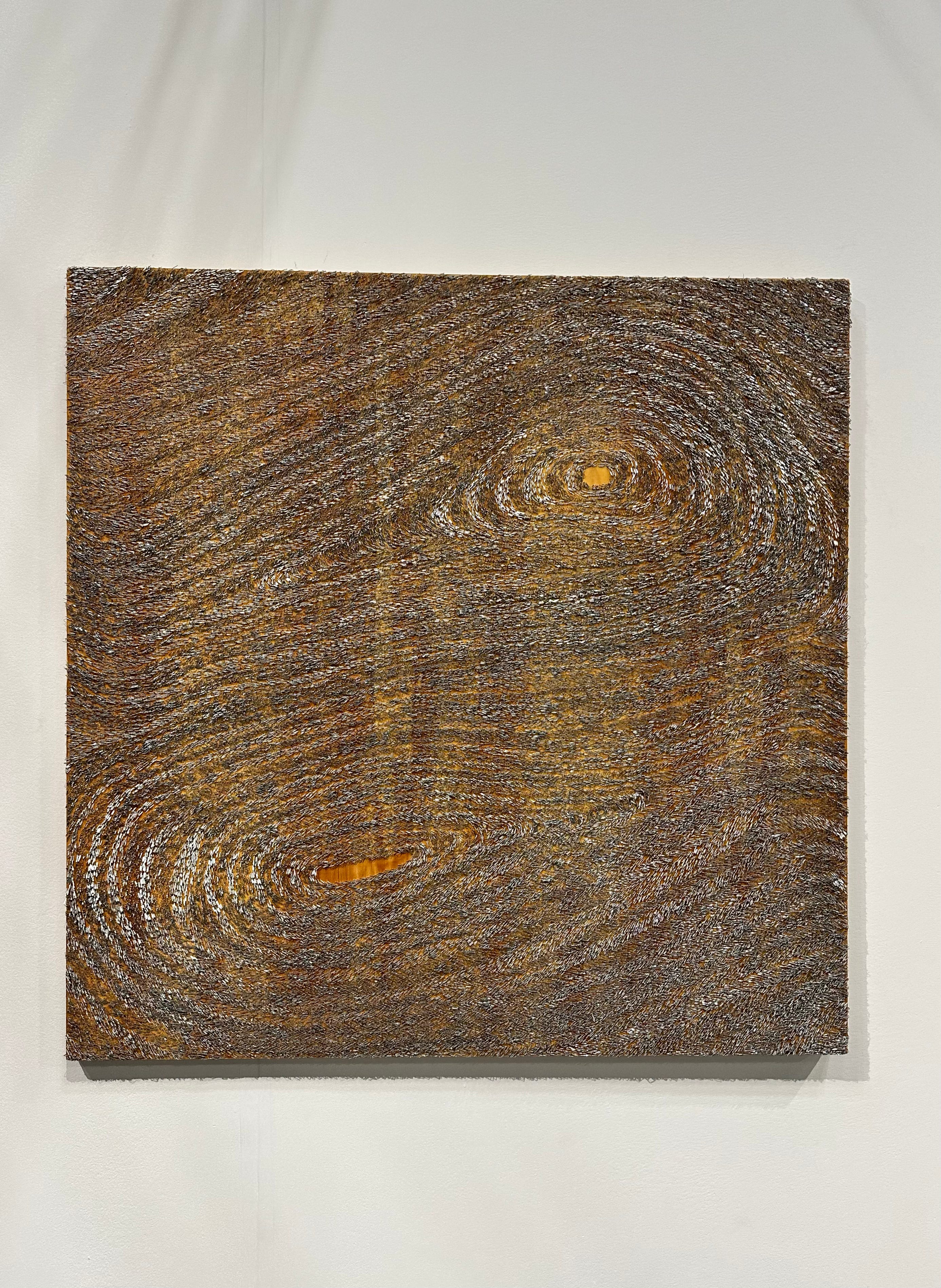
Wilmer Wilson IV
Survey 1, 2024
Staples on wood
48 × 48 × 1 3/4 in.
Some artworks you feel in your bones. Wilmer Wilson IV’s was one of them. At first glance, it appeared as a massive, textured surface, intriguing yet enigmatic. As I moved closer, the medium became clear: staples, thousands layered meticulously to create a shimmering play of light and shadow.
The staples caught the light in a way that made the surface seem alive, shifting with every change in perspective. It was tactile without touch, engaging senses beyond sight. The sheer labor involved in placing each staple spoke of dedication, repetition, and the passage of time. I contemplated the act of stapling: simple and mundane, yet here transformed into something greater. Each staple, a tiny, forceful insertion leaving a permanent mark. I then reflected on how often do we feel the need to assert, “I am here,” in a world that easily overlooks us?
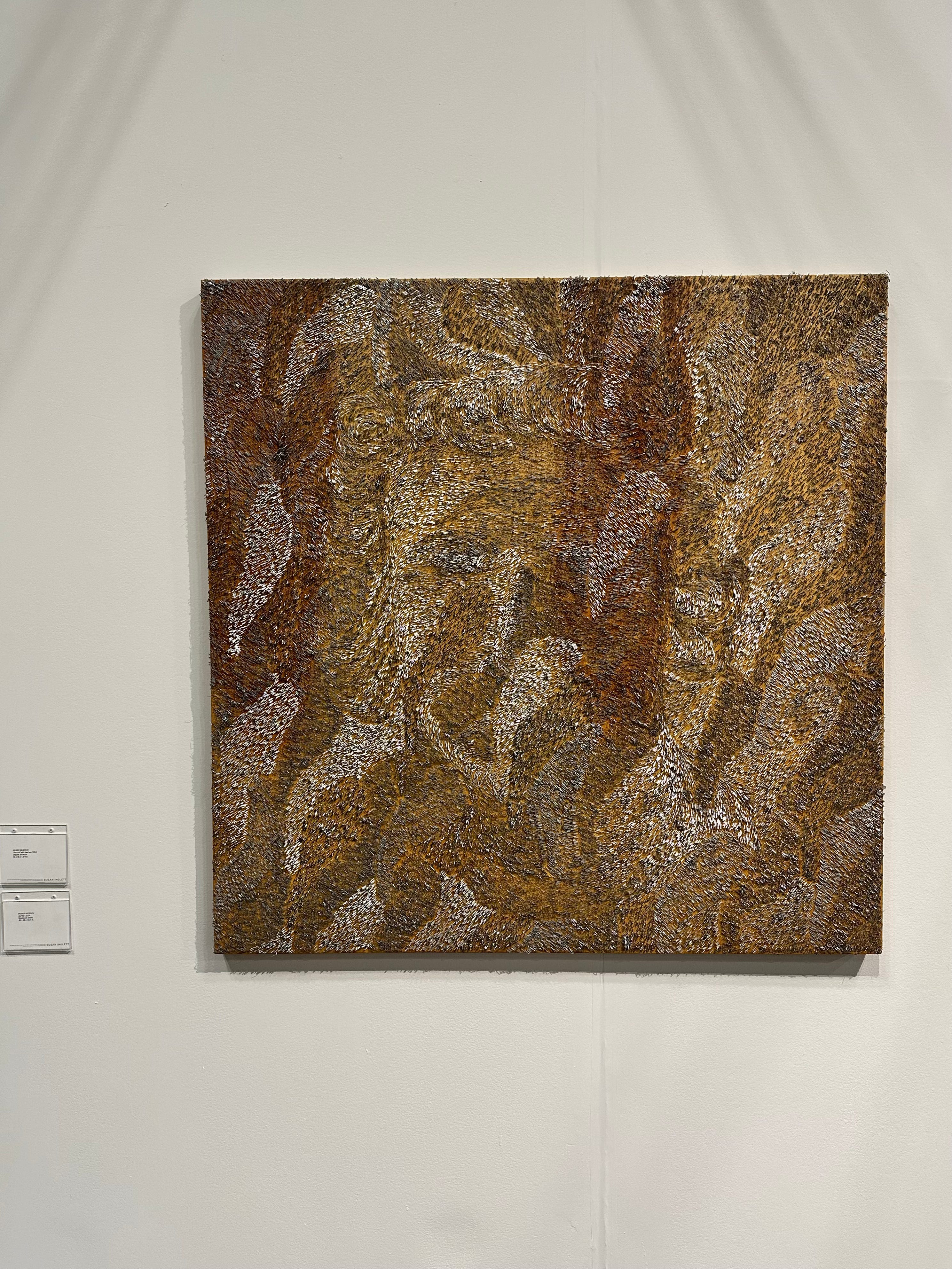
Wilmer Wilson IV
Standoff with Leeches, 2024
Staples on wood
48 × 48 × 1 3/4 in.
Some artworks you feel in your bones. Wilmer Wilson IV’s was one of them. At first glance, it appeared as a massive, textured surface, intriguing yet enigmatic. As I moved closer, the medium became clear: staples, thousands layered meticulously to create a shimmering play of light and shadow.
The staples caught the light in a way that made the surface seem alive, shifting with every change in perspective. It was tactile without touch, engaging senses beyond sight. The sheer labor involved in placing each staple spoke of dedication, repetition, and the passage of time. I contemplated the act of stapling: simple and mundane, yet here transformed into something greater. Each staple, a tiny, forceful insertion leaving a permanent mark. I then reflected on how often do we feel the need to assert, “I am here,” in a world that easily overlooks us?
It’s the quiet resilience required to navigate life’s challenges and the persistence to push forward even when recognition isn’t immediate. Individually insignificant steps become collectively formidable. Standing before his piece, I felt a kinship with that persistence, the human spirit’s capacity to create meaning and beauty through steadfast effort, even amid chaos. Wilson’s art didn’t just appeal to my eyes; it prompted me to reflect on my own journey and the marks I hope to leave.
My visit to the Armory Show was a highlight of my year. Each piece I connected with was a conversation between the artist’s intent and my reflections. Khalif Tahir Thompson reminded me of the strength found in vulnerability and the importance of embracing our hidden selves. Natvar Bhavsar showed me the value of looking beyond first impressions, encouraging me to find peace in the subtle and the expansive. Wilmer Wilson IV inspired me to acknowledge the power of persistence and the significance of every small action we take.
These experiences are not unique to me. Art holds this potential for all of us. I invite you to consider where you might find pieces of yourself in the world around you. What stories are waiting to connect with you? It could be in a painting, a song, or a quiet moment in nature that reflects something you’ve been missing.

Allow yourself the grace to explore these connections. There’s no right or wrong way to experience life, only the journey it takes you on. So, the next time something catches your eye, pause and let it speak to you. You might find it’s telling your story, too.
with care,
emma
Orginally published October 4th, 2024